
Last week I shared a reflection on how young the profession of interior design actually is, and how interior design history gets written.
When you compare it to architecture, law, or medicine, interior design is barely one hundred years into defining itself as a formal profession. That context explains a lot about the challenges designers still face today around authority, value and recognition.
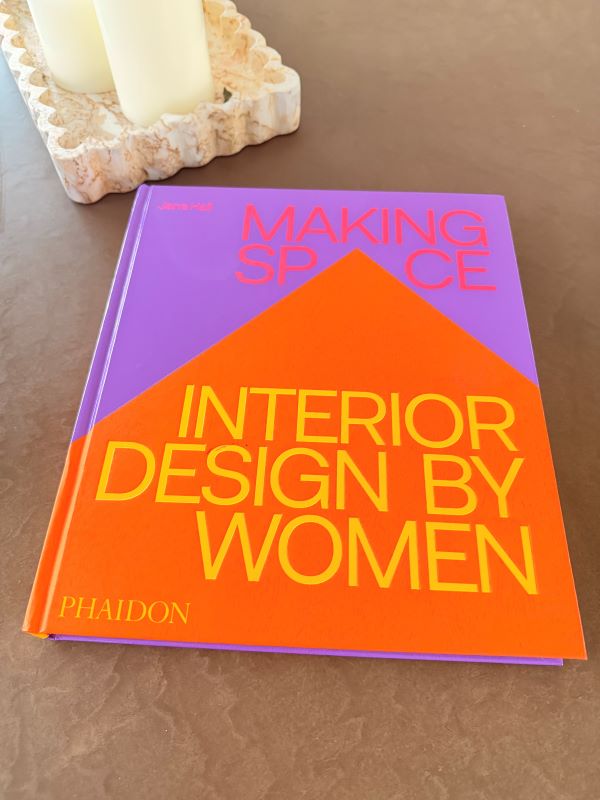
While researching that piece, I had been reading Jane Hall’s book Making Space: Interior Design by Women. which looks at designers from the late nineteenth century to the present day.
Naturally, I became curious about the process behind the book itself.
With such a broad group of designers included, I wondered how those individuals were selected. Were there specific criteria? Were the themes established first, or did they emerge during the research?
So I wrote to Jane Hall and asked.
Her response was fascinating.
Rather than starting with fixed themes, the selection process looked for designers who had contributed significantly to design history, had been particularly pioneering, or whose stories had not always been fully recognised. In particular, the book sought to highlight women whose work had historically been overshadowed by male collaborators.
Some designers were also included simply because their stories were unusual.
As Jane explained when describing the selection process:
“We were unable to include a lot of historical figures simply because no images of their interiors exist, which was a shame.”
Without photographs, their work could not be documented in the same way.
In other words, visual records help determine who becomes visible in design history.
The Problem of Visibility
It raises an interesting question.
How many designers have produced significant work that simply wasn’t documented?
Interior design is a profession built largely around private spaces. Unlike architecture, which leaves physical structures that can be studied for centuries, interiors are often temporary. They change with new owners, new fashions, or renovations.
If the work isn’t photographed or recorded, it can disappear surprisingly quickly.
Which means that history may only capture a fraction of what was actually created.
Even today, designers invest considerable time and money into photographing projects once they are completed. Those images are then shared across social media platforms or submitted to lifestyle magazines.
But this raises another question.
Are these platforms building a lasting archive of design work, or are they simply moments of visibility that disappear within fast-moving digital feeds?
Lifestyle magazines have traditionally acted as a form of cultural documentation. Publications like World of Interiors or Elle Decoration have helped define what the public sees and understands as design.
But in the age of Instagram, the process is changing.
Designers now publish their work directly.
The reach can be enormous, but the permanence is less certain.
The Elusive Designer
Another insight from Jane Hall’s research was something she found quite surprising.
When she interviewed many of the designers included in the book, a number of them denied having a distinctive style.
This is interesting because when you look at their work, their authorship is often unmistakable.
Instead, many described their approach as responsive to clients rather than stylistically driven.
Jane described the interior designer as an “elusive figure”.
Even when published, interviews and profiles often remain quite generic, offering little insight into the deeper thinking behind the work.
That mystique has always been part of the profession.
But it also means that understanding the real contributions of designers can be more difficult than in other fields.
What Today’s Designers Might Take From This
Reading these stories, another pattern begins to emerge.
Many of the designers who became historically recognised came from particular environments. Some studied at prestigious institutions. Others moved between countries where design industries were more developed.
Recognition often took decades.
Their careers were shaped by the conditions of their time: economic crises, wars, industrial change and shifting cultural values.
In other words, every generation of designers faces its own challenges.
Today there is a lot of discussion about new pressures on the profession, from artificial intelligence to changing business models.
But when you look at the last hundred years of design history, it becomes clear that uncertainty is not new.
What may matter more is how designers document and communicate their work over time.
Because ultimately, history can only record what it can see.
A Question For Irish Design
One other observation stayed with me.
As I looked through the designers included in the book, I noticed that none were from Ireland.
That isn’t necessarily surprising when you consider the scale of the global design industry. Larger countries have more established networks of institutions, publications and archives that document design work.
But it does raise an interesting question.
If design history is partly shaped by documentation and visibility, what does that mean for smaller design communities?
And what responsibility do individual designers have in recording their work for the future?
These are questions I’m increasingly curious about as I continue exploring the structure of the profession.
Not as criticism, but simply as a way of understanding how influence and recognition develop over time.
The more I read about the last hundred years of interior design, the more I realise that history rarely forms by accident.
It is shaped by documentation, by media, by institutions, and by the designers who choose to record and share their work.
Perhaps that is one of the quiet responsibilities of the profession today.
Not simply to design beautiful spaces, but to ensure that the work itself is documented, discussed and understood.
Because history, in the end, only remembers what it can see.